

Solutions · Finance
Predictive models over a unified financial knowledge graph
The problem
The signals that move markets are scattered across filings, legal records, supply-chain data and news — in different formats, from different vendors, with no shared structure. Models built on siloed feeds see correlations but not the relationships behind them: who supplies whom, who is suing whom, which approval unblocks which product.
Our approach
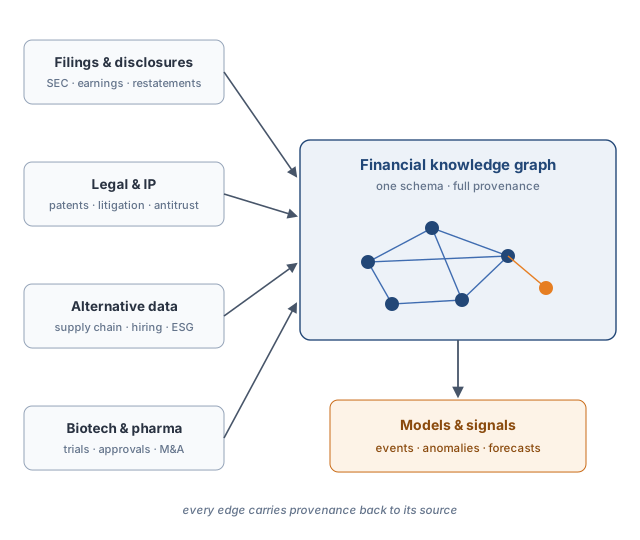
We connect those sources into one financial knowledge graph with an explicit schema: entities, relationships and events, each carrying provenance back to the document it came from. Predictive models then operate on that structure — exploiting dependencies and causal paths rather than correlation alone.
Data
Unified data integration
Diverse financial, legal and alternative sources are structured into one dynamic knowledge graph, capturing the connections between financial entities, regulatory events and market movements.
Financial & regulatory filings
SEC disclosures, earnings call transcripts, financial restatements, and insider trading activity.
Legal & intellectual property data
Patent filings, infringement lawsuits, antitrust investigations, and class-action cases.
Real-world & alternative data
Geospatial tracking, supply chain disruptions, hiring trends, and ESG risks.
Biotech & pharma data
Clinical trials, FDA/EMA approvals, and biotech M&A deals.
Models
Models that use the graph
The knowledge graph is the feature store: models draw on explicit relationships and event chains, not just co-movement in the data.
Graph neural networks
Learn representations of financial relationships directly from the graph structure, surfacing dependencies that flat feature tables miss.
Causal models & Bayesian inference
Separate cause-effect relationships from spurious correlations before they reach an event-driven strategy.
Temporal graph embeddings
Track how relationships between entities evolve over time, capturing regime shifts as they form.
Event & anomaly detection
Flag abrupt changes in filings, supply chains and market data — each alert linked to the entities and documents behind it.
Outcome
What you get
- One queryable graph across filings, legal records and alternative data — instead of siloed feeds.
- Event and anomaly signals with provenance: every alert traces back to the source document.
- Models that use the structure of the market — entities and their relationships — not just correlated time series.
A graph you can inspect: when a model flags an event, you can open the entities, the relationships and the filings behind the signal.
Request a demo