

Your data has structure.
Your tools throw it away.Knowledge graphs from any data — modeled as code, portable across eight backends.
GrowGraph composes structured records and unstructured documents into one governed knowledge graph, then serves it to your applications, your analysts and your AI agents alike — from a single versioned model you own.
Structured data
SQL · CSV · APIs
Unstructured documents
PDF · reports · notes
GraFlo
declarative schema
OntoCast
ontology-guided extraction
One knowledge graph
typed, versioned, queryable
Graph DBs
Neo4j · Arango · …
RAG
grounded answers
Analytics
models & APIs
The problem
Knowledge graphs are valuable. Building them is where teams stall.
One-off ETL per database
Every new graph store means another brittle ingestion script. Schemas drift, pipelines break, nobody wants to touch them.
Documents left behind
The facts in your PDFs, reports and notes never make it into the graph — the knowledge that matters most stays unqueryable.
Agents can’t improvise structure
An LLM agent handed a raw schema dump cannot compensate for a model that was never written down. A 400-type dump is not usable context — it’s noise.
The platform
Construct. Govern. Serve.
GraFlo composes structured sources into a governed model. OntoCast reads documents into auditable RDF. The platform serves it all — to databases, dashboards and agents.
GraFlo
Open sourceDeclare your schema once. Any data, any graph database.
A declarative data-to-graph transformer: define vertices, edges and identities in one schema, then ingest SQL, CSV or API data into Neo4j, ArangoDB, Postgres and more.
Learn more
OntoCast
Open sourceOntology-guided extraction into RDF you can audit.
An agentic framework that turns unstructured documents into semantic triples, guided by your ontology — every fact grounded in its source.
Learn more
OntoCast API Platform
Early accessDocuments in, governed knowledge graph out.
The managed pipeline: hosted extraction, ontology management, RDF export and SPARQL queries — without running the infrastructure yourself.
Learn more
What dbt did for SQL transformations, GraFlo's GSTL does for graph modeling: the model is code — reviewable, diffable, auditable.
How it works
One pipeline for both kinds of data
Structured data flows through GraFlo's declarative schema. Unstructured documents flow through OntoCast's ontology-guided extraction. Both land in one knowledge graph — served to your graph database, RAG stack or analytics.
01
Declare
Define your graph once — vertices, edges, identities — in a declarative schema. No per-database custom code.
02
Ingest
Stream tables, files and APIs through GraFlo; extract triples from documents with OntoCast, checked against your ontology.
03
Serve
Query the graph from Neo4j, ArangoDB, Postgres, triple stores and more — and ground your LLM answers in facts you can trace.
For AI agents
A governed context plane for AI agents
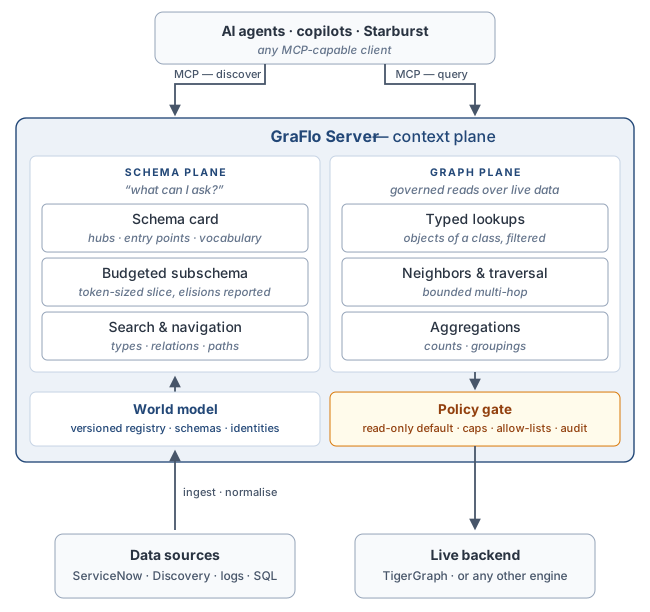
GraFlo's Agentic Context Plane serves your world model to LLM agents over MCP: bounded schema context, read-only access, hard caps — governed by default.
Bounded context
Budgeted subschemas instead of raw dumps: the agent sees exactly the slice of the model it needs, within its context window.
Deny-by-default reads
Every connection is read-only under hard caps — traversal depth, result size, timeouts — enforced before a query reaches the database. The unconfigured state is the safe state.
Ten MCP tools, eight backends
Schema introspection, traversal and capped queries over all eight supported backends, through the protocol agents already speak.
Run it today
Open code you can inspect. pip install today.
OntoCast and GraFlo are both open source (Apache-2.0), published, documented and citable — run them yourself before you ever talk to us.
Resources
The architecture, argued in full
Longer pieces on the problems behind the product — how a graph is served to agents safely, how a model changes without breaking its consumers, and what portability actually requires.
Governed context for AI agents over enterprise knowledge graphs
Why agents fail on enterprise graphs, and what a context plane has to provide before an agent can be trusted with one.
Read the paper
Version control for world models
Enterprise models change constantly, and most graph stacks have no answer. What version control looks like when the artifact is a schema rather than a codebase.
Read the paper
Database independence for knowledge graphs
What graph database lock-in actually costs, what portability genuinely requires, and where the honest boundary of it sits.
Read the paper
The OntoCast platform is open in early access.
Sign in to the console; new accounts are approved by our team before their first extraction. Or leave your email for updates, or tell us about your use case and get a guided demo.
Prefer a conversation? Request a demo